


What Our Pilots Have Revealed So Far
Real Properties. Real Inspections. Real Risk Trajectories.
Across six pilot assessments—including small multifamily properties, public housing communities, mid-rise buildings, and high-rise towers—QNRI™ has revealed a critical truth:
Passing NSPIRE does not mean risk is under control.
Our pilots were conducted alongside real HUD inspections—not hypotheticals, not simulations. What we observed consistently across every asset type is this:
Compliance is achievable.
Sustainability is not—without governance.
The Proof Case: From 0 to 86—and Still at Risk
One pilot involved a 12-story public housing high-rise with a long history of failure under legacy UPCS inspections.
Before NSPIRE
Repeated failing UPCS scores
Chronic life-safety and systems exposure
Pre-NSPIRE Readiness Inspection (Full Census)
Score: 0
2,100+ deficiencies
300+ Life-Threatening
Official NSPIRE Inspection (Post-Remediation)
Score: 86 (Passing)
This turnaround proves something important:
Even severely distressed properties can achieve compliance.
But QNRI™ revealed what the score did not.
Post-NSPIRE QNRI™ Findings
Moisture-driven sprinkler corrosion restarting degradation cycles
Roofing and envelope defects likely to reintroduce water intrusion
Passive fire protection failures not fully governed
Electrical protection gaps recurring across systems
QNRI™ Portfolio RISC™ Score: 5 / 5 — Critical
Projected trajectory without governance: regression, repeat findings, emergency repairs
Conclusion:
A strong NSPIRE score does not equal controlled risk.
What NSPIRE Does Exceptionally Well
NSPIRE, implemented nationally between 2023 and 2024, unified HUD inspections around:
Units – Interior living spaces
Inside – Building systems and common areas
Outside – Exterior and site conditions
Deficiencies are classified as Life-Threatening, Severe, Moderate, or Low, producing a standardized 0–100 score.
Life-Threatening and Severe deficiencies (including exposed energized conductors, missing smoke alarms, and high-risk electrical conditions such as missing GFCI/AFCI protection) require 24-hour correction.
Moderate and Low deficiencies carry longer timelines.
This framework has dramatically improved consistency, objectivity, and life-safety enforcement.
What NSPIRE Was Never Designed to Do
NSPIRE is intentionally a point-in-time compliance system.
It does not govern:
How moisture intrusion compounds electrical, structural, and fire-protection failures
How recurring deficiencies trend toward future enforcement
How latent risks distribute across units and systems
What happens between inspection cycles, where most cost and liability emerge
This is the gap our pilots exposed—every time.
What QNRI™ Adds (And Why It Converts Inspections Into Control)
QNRI™ is a non-regulatory, judgment-based risk-governance framework applied during or after NSPIRE inspections.
It evaluates nine critical building domains:
Structural • Envelope • Life Safety / Egress • Passive Fire • Active Fire • Electrical • Plumbing • Mechanical • Fuel Gas
Each domain is scored using the Risk Index for Systemic Conditions (RISC™) on a 0–5 scale, identifying whether risk behavior is:
Static – Stable, controlled
Escalating – Worsening over time
Critical – Severe, uncontrolled exposure
QNRI™ assigns:
No compliance status
No enforcement outcome
No regulatory penalty
Its sole purpose is governance.
QNRI™ makes between-cycle risk visible—before it becomes enforcement, liability, or emergency cost.
What All Six Pilots Revealed—Consistently
1. Interconnected Risks Drive Failure
Envelope breaches were directly linked to electrical degradation, fire-system corrosion, and passive fire failures.
Electrical hazards escalated from “isolated defects” into portfolio-wide vulnerabilities once moisture, repetition, and distribution were evaluated together.
2. Escalating Trends Exist Even at “Good” Properties
Properties that passed NSPIRE still showed:
Recurring smoke-alarm placement errors
Directional structural cracking below collapse thresholds
Repeat electrical protection failures trending toward future enforcement
NSPIRE captures condition.
QNRI™ captures direction.
3. Between-Cycle Risk Is the Real Cost Driver
Across all pilots, unmanaged between-inspection risk led to:
Repeat NSPIRE findings
Emergency repairs instead of planned capital work
Increased liability exposure
Operational disruption and resident complaints
QNRI™ was built specifically to govern this interval.
What This Means for Owners, PHAs, and Asset Managers
QNRI™ enables you to:
Reduce repeat NSPIRE findings
Lower emergency repair frequency
Prioritize capital intelligently
Strengthen insurer and lender confidence
Demonstrate defensible risk governance
Inspections establish compliance.
Governance determines sustainability.
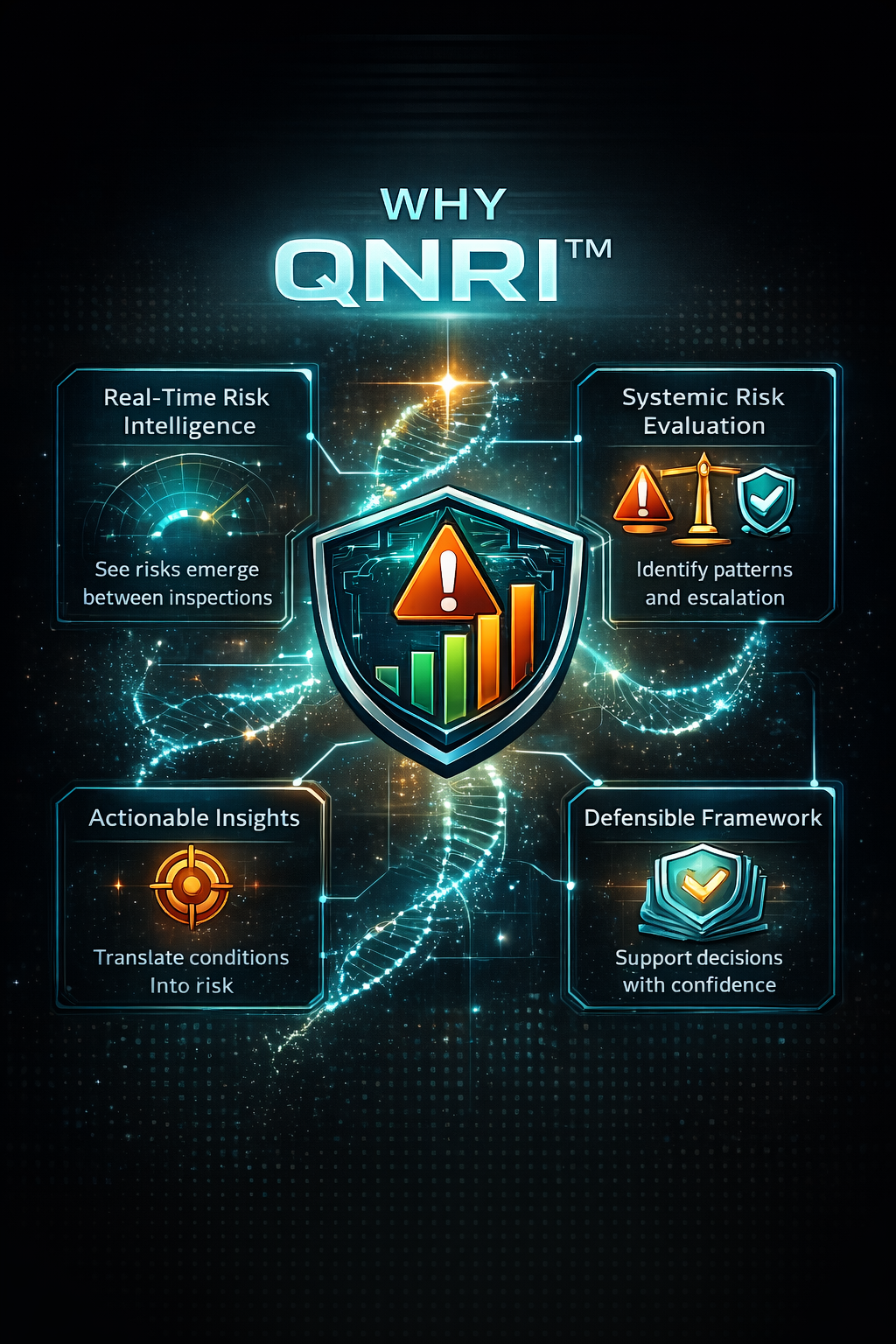
QNRI™ is a proprietary framework developed and field-tested by Quandamn Inspection Services, LLC, drawing on over 18 years of building inspection and HUD housing experience.
It does not replace NSPIRE.
It completes it!
Ready to See What NSPIRE Does Not Measure?
Schedule a QNRI™ Assessment and gain visibility into your portfolio’s between-cycle risk—before it becomes enforcement, liability, or emergency cost.
📧 support@quandamn.com
🌐 www.quandamn.com
QNRI™ — Because passing once is not the same as staying safe.